Posts

Showing posts with the label Create

Enriching Your Reading Programme

What a way to end a term! This morning we fled our classrooms on the promise of coffee, pastries and a day full of professional development at Glen Taylor School. It was a fantastic day full of experts sharing their knowledge on effective reading practice. Ko te Kāhui Ako o Manaiakalani - Dr. Rae Siʻilata and Kyla Hansell   The day kicked off with a keynote by Dr Rae Si'ilata.  This was inspirational. My biggest takeaways were to use more bilingual texts, to broaden my use and understanding of multi-modal texts and how sharing the power in the classroom is so important. I will be looking further into these slides and reflecting more about the provocation in the holidays. Engage the High School Reader with Multimodal Resources - Kerry Boyde-Preece and Maria Krause   This was a fantastic refresher about the use of multi-modal resources, not only to build engagement but to enable students to be more cognitively challenged. This is something I am always interested in; ...
Distance Teaching Take Two!

 With Auckland experiencing its second Lockdown, we educators once again leapt into action and changed our programmes overnight. We know that online distance teaching looks little like the teaching we do in our classrooms, but at least this time we had experience to draw upon. In response to this second wave, I recorded this video illustrating what my lessons look like this time around. I captured the sequence of the lesson (which is mostly asynchronous) and discuss the adaptations that I have made to my teaching since the first lockdown. To see more lessons from lockdown and to get access to the slides and planning in this lesson, check out Manaiakalani Google Class OnAir.

Bringing Code into the Classroom

Image
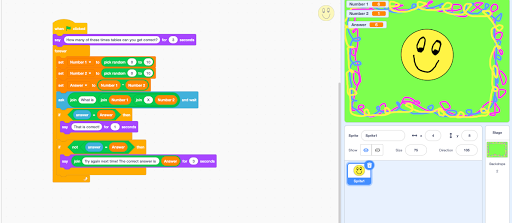
Since coding entered the NZ curriculum, there has been a real surge in teacher professional development in this area.  Personally I am thrilled to see an increasing number of students find the joy in code. It really does feel good to programme something, no matter how simple it might be. I have been very fortunate to have been able to include coding in my teaching since I first started out, thanks to the PD I received from  organisations such as OMGTech! and events such as EdTech Summits. The biggest enabler to my teaching however, is definitely the hour of code . If you haven't been on this site before then you have my blessing to stop reading this post and sign up to the site right now. Seriously, it makes coding so simple!                  There is of course some skill required to integrate coding into your current programme. This was why my colleague Hannah West and I lead a short workshop into bring code into maths. We hope t...

Online Distance Teaching During Covid-19

If you asked me two weeks ago how prepared I felt to teach exclusively online, I probably would have laughed. I found it really hard to imagine a world where I couldn't visit my classroom or speak to my students face to face. But we have adapted and we have a programme underway.          In fact, we managed to get up and running on Tuesday - the first day that our students weren't able to attend physical school. My team leader had decided that we should begin to teach our students what distance learning might look like on Monday (this was awesome as many of us thought we would have longer at school), so we just managed to teach our students some protocol and gave some quick advice before we closed our doors. Since then, we've been able to stay in contact and deliver our lessons through Google Sites and Google Meet/ Hangouts. In the short video above, I explain what our daily programme looks like and how we plan for learning. I really hope the video gives...

Making magic with Google Draw

Image
While it is easy to get carried away with a range of apps, extensions and sites when you are a digital teacher, it is important not to focus more on a cool tool than your lesson content. In the spirit of this, Clarelle and I decided to run a session about Google Draw, to show how one simple tool can be used to do a range of things. This was a really fun session to run - it started off with us talking about the things that we use all the time, like sketchnoting, annotating, hyperdocs (or hyperdraws). We then looked at some of the more artistic things that you can do with Google Draw, I had a lot of fun with this part, but it wasn't for everyone! We also went through some of the tips about how to use Google Draw. Some of them were really basic, such as changing the size of the Google Draw, but they are still really useful to know!                    

Sticky Learning with Hyperdocs

Image
When I used to think about Hyperdocs, I immediately imagined a page filled with hyperlinks. After a session with hyperdoc guru Lisa Highfill, I realise that I may have been wrong about them, in fact, they are not so different from the type of slides that I have been creating for my own learners. The docs and slides that Lisa creates have a definite structure, they clearly take the students on a journey, which for me would look like 'learn, create, share', while for Lisa this might look more like 'explore and explain'. The slides have short instructions and they use images and a layout that is visually appealing. The other misconception that I had about hyperdocs was the number of links that they would feature. Yes, student choice is wonderful, but nobody likes to be bombarded with links as this can become overwhelming. I was pleasantly surprised with the number of links that Lisa's slides provided; the links were purposefully chosen and took students to engagi...

Teaching Algebra with Coding

Image
Now this sounds like something my maths class would enjoy - many of us are pretty passionate about algebra and we already really enjoy coding. However, I also have students who fear this dreaded subject and some have already asked when we will be learning it this year (perhaps hoping that it might align with a terrible pre-planned illness of family holiday). We started by having a look at algebra on spreadsheets - using functions to write the equations. These were like a more interactive version of a worksheet, but I actually enjoyed completing them alone. It is easy to see how this would translate to coding, taking the engagement and interaction up another level. When it came to generating our pattern we did things a little differently; we jammed on chrome music lab and created a simple song using its song maker function. This was such a fun way to see maths in the world - there are patterns everywhere! We then went onto scratch to code some music - each note is here repr...

EdTech Auckland; Time to Wonder

Image
There are no new ideas. This was the idea that keynote speaker Lisa Highfill opened with at Aorere college this morning. She experienced this first hand as she watched her inventor father come up with new products, prepare to launch them only to find another company had already produced them. This might sound a little defeatist, but she went on to explain that the value in an idea is putting it out there and sharing it. Instead of focussing on new ideas, Highfill suggested that we focus on sparking curiosity in our learners, so that they create, build on and share good ideas with one another.                                 We considered different ways to elicit student thinking, dreaming and wondering. This could be through engaging multimodal sites, stories, videos, google earth... But they must ask questions and discuss their thinking with one another. This aligns very closely with the Learn, ...

Leading Learning Through Google Sites

This morning Clarelle and I lead a workshop discussing the way we use Google Sites to lead learning. There is a lot we will adapt for our next presentation but it was a great opportunity to share our learning and to realise how far we have come in our learning journeys so far!                 

Design Thinking at KPMG

Image
Today has been both fustrating and rewarding, as I have spent the day grappling with big issues with the Manaiakalani Innovative Teachers. The purpose of the day has been 'design thinking' to think of a prototype that would address the problem that we have identified. We were fortunate enough to spend this time at KPMG with Justine Todd. My original problem was looking at the connection between Intermediate and High School, as I was concerned that my students were not being adequately prepared to meet the literary demands of college. However, as I explored the problem in greater depth, I realised that this was just one of the affects of the true issue, outlined below. I then gathered information about this issue by talking to a range of experts in the field and collecting more data. I realised that my students struggle to use academic language and to comprehend the language of learning. This means that they use a lot of colloquial terms in their writing and that it is n...

MIT Retreat: possible approaches?

Image
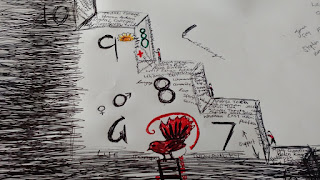
Later in the MIT retreat we looked at the people involved in the issue and those that could support us to facilitate the approach. I created this diagram to represent those that are involved in my issue to support me to explore it in greater depth. It was during the creation of this diagram that I realised how helpful it would be for me to discuss the issue with other educators - those teaching at year six, at intermediate, at the college and with Manaiakalani facilitators and senior management. After unpacking the problem we were tasked with imagining different approaches that might address the issue. We had to create eight ideas to ensure that we were thinking broadly and widely (we could be as imaginative as we liked). The hearts indicate which approaches the educators favoured From creating these possible approaches it became obvious that a link between college and intermediate might not help my year sevens, although it might make life a little simpler for the year e...

Creativity Empowers Learning

Image
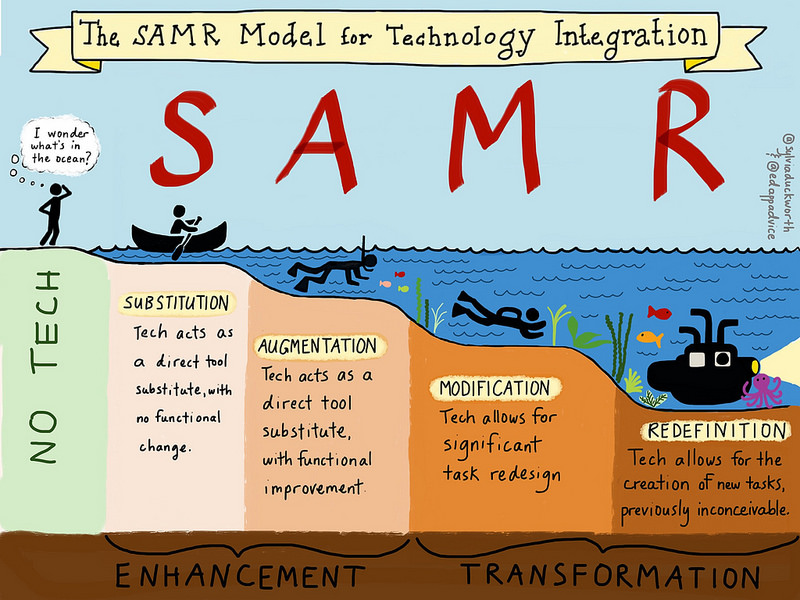
This week our staff meeting was run by Fiona Grant, who came to talk to us about the way that creativity empowers learning. As our  Manaiakalani pedagogy is 'Learn, Create, Share' our students are given regular opportunities to create and to be creative. However, not all create activities are equal. When we consider the SAMR model, we know that we can design activities at the Substitution, Augmentation, Modification and Redefinition level of the model. We know that we cannot always design tasks at the top two levels of this model, and that substitution has its place.                                                           image by Sylvia Duckworth Fiona reminded us that often Modification and Redefinition level tasks can be more time consuming than those at the Substitution and Augmentation level. However, students can achieve a...

Te Reo Māori

Image
As someone who completed the majority of their schooling overseas, I cannot say I experienced any Te Reo Māori lessons when I was at school. As such, when I began teaching last year I was a little unsure of how much Te Reo is usually taught and how these lessons are structured. Naturally, there is a lot of variation between courses and different ideas of how best to support the development of the language. Fortunately, I was able to experience Te Reo lessons first hand as I enrolled in two different courses as a student.                                                     Learning about the colours While I was a student at Auckland University, I took a linguistics paper in Te Reo Māori which helped me to develop an understanding of the structure of the language and supported me to build a basic vocabulary. As I still struggled with pronunciation and ...

Integrated Inquiry Approach

Image
For the first part of the term,  our inquiry topic has been focussed on animals and being a responsible pet owner. I integrated maths, reading, writing, inquiry, technology and art as to maximise the amount of learning that could occur in the short time that we were given. I was amazed by how much content we covered and how much the students learnt. My reading books aligned directly with the inquiry science lessons, where we investigated classification, adaptation and the food chain. I ensured that my students were engaging with multimodal text types each week and that we read a few texts that covered the topic in depth. I found that these reading lessons were very successful; the students made connections between their prior knowledge/ learning and between the texts.This aligned with a wide and deep reading approach, which Glenbrae and other Manaiakalani schools are focusing on at the moment.                       ...

Getting Creative

Image
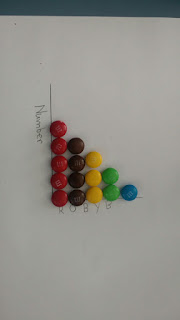
After engaging with a summer school paper regarding digital teaching and learning, I feel more inspired than ever to make greater use of the technology in my 1:1 Chromebook class. This year about 95 percent of my students own a Chromebook and the others can work 1:1 due to the PC's that are available in my class. This has allowed me to step up my digital teaching and create more activities that align with the augmentation, modification and redefinition level of the SAMR model. Using MnMs while looking at different types of graph in statistics So far this year, the students have used Tagul to create posters, Infographics to convey statistical information, Answer Garden, Kahoot and Padlet to share their ideas, Google Forms as exit cards, Sketchnotes to illustrate their maths strategies and Google Slides to present their learning during our school science week. I have used technology more meaningfully in these first five weeks than I was able to do last year thanks to the cu...

My Learning Journey

Image
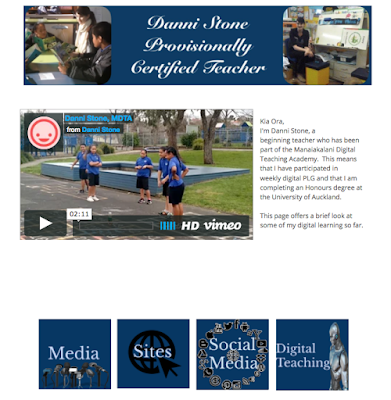
During our final PLG of the year we created sites to display our learning this year. It was a great opportunity to reflect on our growth over the year and consider how fortunate we have been to have had this support. I think learning (and creating) the digital component of the MDTA has been one of the most enjoyable aspects of the course, after teaching the children of course! We have had the opportunity to create several different sites, videos, to code and animate - things I may never had tried otherwise! Have a look at the site that I have created to see some examples of these creations. Despite not having our Friday PLG's next year, I will still continue to make a conscious effort to develop my digital knowledge and to continue my learning journey.

Class on Air

Image
I have written before about my admiration for the teachers who participate in Manaiakalani Google Class on Air.  At the beginning of the year I found it intimidating simply to publish my lessons online, so it seems incredibly brave to film a live lesson! However, this is what we have been planning in todays PLG (although ours won't be published on the Class OnAir site).                 For my Class OnAir style lesson, I have decided to try a teaching strategy that I have been planning for some time. I have noticed that a few of my learners still need support in developing detailed ideas in writing and that working collaboratively has provided some support. I have also been looking at bringing gaming into my lessons as this is something that my learners are interested in. So, I introduced the idea of playing Dungeons and Dragons with them. Unfortunately we experienced several technical issues when filming this video, so I have incl...

Visible Learning

Image
Are you teaching to accommodate you students learning preferences or simply teaching with your learning style in mind? This was a point of discussion in todays Manaiakalani digital immersion PLD which focussed on the notion that visible teaching and learning enables accelerated shift. We looked at this in the context of creating visible learning through our class sites, which must be both behaviourally engaging or interesting, and cognitively engaging which could be achieved through multi-modal activities. I believe that while my learners have learning preferences, they learn best when offered the opportunity to access information in a number of modes. While I have been successful at introducing topics in multiple modes and using a variety of multi-modal create activities, much of my teaching in reading has focussed on my learners first responding to a text orally and in written form.  However, our class site and 1:1 classroom environment allow me to go further than this an...

Hour of Code

Image
If you asked me during my high school ICT classes if I saw myself coding in the future, I would have laughed.  I felt overwhelmed and slightly uninspired when I was given the task to write a few commands in Javascript. However, when I encountered the Hour of Code last summer, I discovered coding in a new light and completed the 20 hour Accelerated Intro to CS course  out of interest! I also realised that this would be valuable knowledge to possess as a teacher, as coding is a skill that could benefit my learners in the future. In fact, thanks to their Computer Technology classes and previous teachers, many of my students are already competent coders. A proud moment for me this year was taking them to OMG Tech , and watching them create their own games through scratch, with little support from the facilitators. As we discussed future focussed learning in our PLG today, I was reminded of the importance of this skill and will definitely consider using the code.org and o...

Ignite presentation!

Image
Ignite presentations are efficient and ensure that the speaker uses their allocated five minutes wisely (and do not run over time). I had first experienced ignite talks at the Manaiakalani Hui, where teachers presented about their inquiries and found the concept impressive but daunting. The concept is simple, you have 20 slides which run for 15 seconds each,  adding up to a five minute presentation. From Try it Tuesdays! Blog In our PLG, we were given the task of creating an ignite talk on a topic that we pulled out of a hat. In my case, I was given the reading "Policies of Distraction" by John Hattie.  We were given three hours to learn about our topic and create our slides. These presentations were created through Keynote , which meant that we would be able to animate and time or slides simply. My slides became simpler as time went on! My topic was concerned with the policies that we create and follow, which do not accelerate learners. Hattie noted things li...