Posts

Showing posts with the label Professional Development

Bringing Code into the Classroom
Image
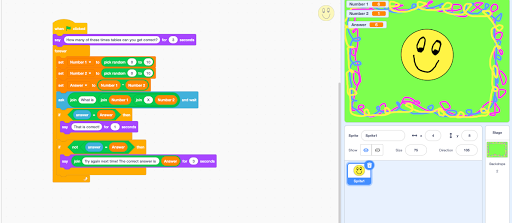
Since coding entered the NZ curriculum, there has been a real surge in teacher professional development in this area.  Personally I am thrilled to see an increasing number of students find the joy in code. It really does feel good to programme something, no matter how simple it might be. I have been very fortunate to have been able to include coding in my teaching since I first started out, thanks to the PD I received from  organisations such as OMGTech! and events such as EdTech Summits. The biggest enabler to my teaching however, is definitely the hour of code . If you haven't been on this site before then you have my blessing to stop reading this post and sign up to the site right now. Seriously, it makes coding so simple!                  There is of course some skill required to integrate coding into your current programme. This was why my colleague Hannah West and I lead a short workshop into bring code into maths. We hope t...

How to Teach Sentence Structure

Image
Does grammar have a place in your writing programme? Previously when I've thought about teaching sentence structure,  I've thought about teaching sentence length or type, such as 'compound' or 'complex'. I didn't think I was doing too badly with this either, until I spent a few hours chatting to Dr Jannie Van Hees over the holidays. I realised that something was definitely missing from my programme! A Problem Over the years I have encountered many students who struggle with sentence structure in different ways. I'm sure we are all familiar with the 'and then' writer. These are children who are determined to fit a whole story into a sentence. " First I woke up and then I had breakfast and after that I watched TV..." need I say more. I've also taught natural poets, writers who write in beautiful utterances: "tears pouring, dreams caged. Useless wings flutter." I have a real soft spot for these writers, but you can ...

Supporting Health and Wellbeing; Students, Parents, Teachers

Image
How would you treat a pupil who came to you and said they were feeling overwhelmed? We teachers are experts at listening compassionately and supporting others through hard times. So why is it that we struggle to do the same for ourselves? This evening I attended a webinar lead by  Clinical Psychologist Dr Natalie Flynn and Dr Nina Hood of The Education Hub. Teacher Wellbeing At the moment, teachers are really struggling to allow themselves to feel stressed or low. We are going through a global pandemic. We are being asked to teach in a totally different way and it is hard. We must acknowledge that it is hard. And then we must stop beating ourselves up for not meeting high expectations. A good first step for teachers, as suggested by Dr Flynn, is to comprise a list of all of the things that you are expected to do. Then negotiate, prioritise,  work out what can feasibly be done and set a time to do it. You wont be able to do everything and that has to be okay.  We a...

Enhancing Assessment

Image
Assessment is a hot topic in education. Often when we think of assessment we think of end of year, high stakes testing, where our students are allocated a grade. However, Professor Stuart Kime  urges educators to look at assessment instead as a process that is vital for effective pedagogy. Here are my takeaways from Professor Kime's assesment webinar at the Education Hub . Assessment should not be looked at as a singular event or test. Instead it should be seen as a process that produces information that can be used and that is meaningful. Yes, it will involve some sort of testing, but when teachers make sense of this test data and act upon it, their pedagogy is strengthened. Testing is often seen as an end goal - we will assess our students at the end of the unit or year and give them a grade. However, the process of assessment can be used throughout the year. We need to know their starting point; to understand where they are at the moment and how/ what we should tea...

Hooking them from Home; Student Engagement in Distance Learning

Image
Are you interested in hearing what the experts have to say about distance learning? I have broken down some of the key learning presented by Harry Fletcher-Wood (teacher, educational researcher and Associate Dean at Ambition Institute) at this evenings Webinar hosted by the Education Hub and Dr Nina Wood. Harry began by discussing the need to prioritise. At the moment teachers are overwhelmed. We're bombarded with offers from educational apps, our Pinterest boards are brimming with ideas and our inboxes are full to bursting with suggestions on remote learning. But if we use every app, tool and suggestion we will overwhelm our students. Instead, we need to focus on establishing new habits and setting simple activities so that our students find working from home achievable and manageable. Forming habits To form these habits, we need to support our students to get into a routine that supports learning.  "After breakfast I will attend a hangout with my class and complete...

2020 Learner Profile

Image
We educators teach a lot more than reading, writing or maths. We spend much time on developing life skills and preparing our tamariki for their futures. With this in mind, we in team five spent our first meeting creating graduating profiles of our learners. That is, we considered the skills, knowledge and traits that we hope they will possess as they leave our classes. This was a fantastic activity (created by my amazing team leader Andrea) that got us on the same page and excited about teaching a new cohort of children. We discussed motivation and resilience at length; we want our students to be driven, to love learning, to persevere and set lofty goals. We also discussed some of the challenges our students face at this age, as they become more self aware (and self conscious) and are beginning to make choices for their future. This is something that hit me hard at the end of 2019 as I started to connect more with teachers at the local college. Previously I had quizzed them on ...

Quantities of Quality Text

Image
This afternoon we were visited by Dr Jannie Van Hees who came to talk to us about language acquisition. She first asked us to consider the literary understandings that our students come to use with and why we need quantities of quality text (both spoken and written). The more books that students engage with, the more concepts they learn about, the more knowledge and vocabulary they acquire. If the texts are too simple, the students will not not learn as much; they need to be challenged with challenging new words and ideas. Children's language acquisition potential is astounding; they have amazing potential to learn. Thus, we must have high expectations of our learners - we need to keep pushing them, giving them learning in their ZPD or 'goldilocks' zone. However, learners need to do their part to; they can't simply listen or view the words, but they need to focus and notice. They must be metacognitive and be aware of their learning of the vocabulary. Jan...

High Expectations Teaching - Christine Ruby-Davies

Image
Are high expectations important?   Educators who hold high expectations of their learners support their self-efficacy and belief. Whilst pushing their students to engage with challenging material, they are not only supporting higher achievement outcomes, but they are also demonstrating their belief in their learners, which in turn supports the students belief in themselves.

GAFE Summit Keynote

Image
Kicking off today's GAFE or EdTech conference at Aorere College was keynote speaker Patrick Green. This keynote was entitled "the relevant teacher" and it focussed on the changing nature of the education system. Patrick took us through some examples of innovative 21st century schools and the way that they have adapted their practice. For example, Sequoyah school in California hold students back twice throughout their schooling to ensure that each child experiences failure and leadership.  He looked at the changing role of teaching and discussed the acts of a relevant teacher. This is a person who questions their content and pedagogy, considering whether what they are teaching will be relevant and helpful to their students. Is it worthwhile teaching students information that they can access through Google at any time? Relevant teachers are aware that students can gather information at any time online and expects students to answer their own questions, to take owne...

Changes!

This year I have moved 1.5km up the road to teach a year 7 and 8 class at Point England School. I was really excited to have the chance to teach year eights again and to gain the opportunity to teach in a hub with four other teachers. I feel absolutely honoured to be able to work with these strong kaiako, as despite finding the move pretty challenging, I have felt really supported by my team. It is taking me a little while to adjust to the routines and differences between the schools, but I am enjoying the journey and I can already feel myself learning a lot because of this. This year I would like to develop strategies that I can carry with me from class to class, as I realised that a lot of my management techniques relied on my strong relationships with my students. This year I will have three different classes and I will be interacting with over a hundred and fourty students on a regular basis, so this will be an important skill to develop. I would also like to continue to develo...

Where it all begins

Image
As I have always been interested in teaching intermediate school students, I have not had much experience teaching younger children. My lowest practicum placement was a year two class, however the learners worked at a year three and four level. I know it is really important for me to develop an understanding of the junior school and my learners experiences when they first came to the classroom. I also need to develop an understanding of how educators support students as they begin to learn to read, write and count, as I will teach students who need this support at my level. I have decided to spend some more time with my buddy class (year 1) who are achieving at a range of levels. I will be taking my class to participate in buddy reading/writing with these learners every couple of weeks and I will spend some of my release time working with these learners. This morning I observed our reading recovery teacher, Mrs Kelly teach a writing lesson to teach the learners about penguins. A...

Mindfulness

Today my class engaged in their first mindfulness session, facilitated by Ara Simmons and Chris Bush. I am really privileged to work with these ladies and to carry out the 'Pause, Breathe, Smile' programme over the course of the term. While I have run a few mindfulness activities before, seeing it put together as a full session was really helpful for me to learn more about the way that it can be taught. After some introductions and a quick chat about mindfulness and being present in the moment, we started with a short breathing exercise using a Tibetan singing bowl. This was a hit with my learners (and myself) as we all felt relaxed listening to the bell ring. We then completed a mindful eating activity where we looked at, smelt, held and tasted a piece of chocolate. We discussed how eating the chocolate mindfully made it taste different to some of us. Finally we took part in a guided meditation and shared our thoughts about the way we felt during this time. I was really im...

Teaching as Inquiry

Image
This term my teaching inquiry has been focussed on eliciting rich discussion from my learners and supporting them to justify their answers. I have been focussing on this across the curriculum and I have found new ways to promote discussion in different areas. In reading I have been using a mixture of reciprocal and guided reading all year. My students are now able to follow the reciprocal reading cycle in their groups without my support, and they can engage in great discussion. However, I have used guided reading alongside this to probe the students for deeper responses; to make inferences and judgements about the text. I also encourage my students to use the text to justify their answers during this time. In writing I have utilised peer feedback to get my students discussing their writing more often. I also use language experiences and text analysis at the start of the year, so that they discuss their ideas before they put them to paper. The use of text analysis has been able to g...

Creativity Empowers Learning

Image
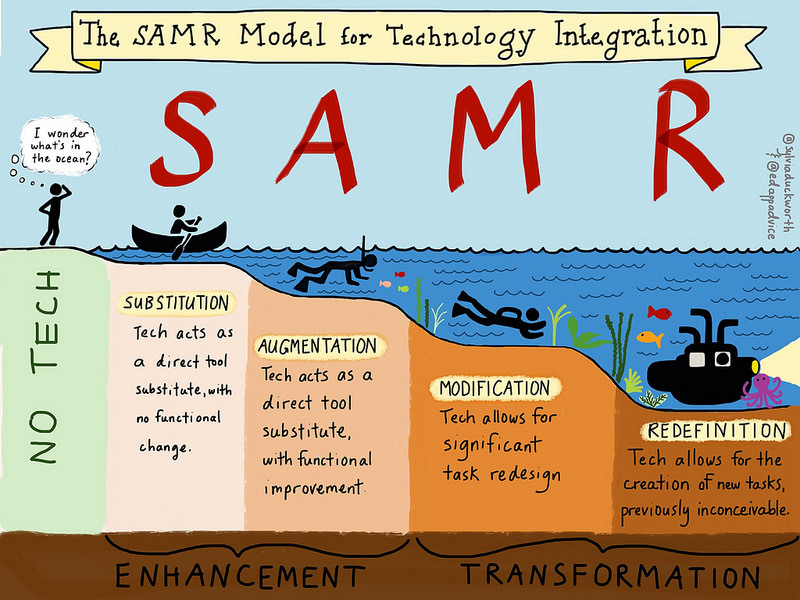
This week our staff meeting was run by Fiona Grant, who came to talk to us about the way that creativity empowers learning. As our  Manaiakalani pedagogy is 'Learn, Create, Share' our students are given regular opportunities to create and to be creative. However, not all create activities are equal. When we consider the SAMR model, we know that we can design activities at the Substitution, Augmentation, Modification and Redefinition level of the model. We know that we cannot always design tasks at the top two levels of this model, and that substitution has its place.                                                           image by Sylvia Duckworth Fiona reminded us that often Modification and Redefinition level tasks can be more time consuming than those at the Substitution and Augmentation level. However, students can achieve a...

Whats on the horizon for technology in education?

Image
This week we began our university summer school course with Rena Heap and Kerry Lee. The course is concerned with digital pedagogy, which is an area we are all involved with and passionate about. Our first task was to create a fifteen minute presentation based on one of the course readings. I chose to cover the NMC/ CoSN Horizon Report: 2016 K-12 Edition. I spent a couple of minutes covering the outline of the report and shared a slide show containing my notes with the class. For the remainder of my presentation I created a mini Makerspace featuring Google Cardboard and robotics. I wanted to give my peers the opportunity to experience some of the technology described in the text. We had a great time running the Edison robots around the track and experimenting with some of the Apps on Google Cardboard. I'm really looking forward to introducing this as part of the technology lessons I teach with my year 6 students, while the year 7's are at Tamaki College.

Visible Learning

Image
Are you teaching to accommodate you students learning preferences or simply teaching with your learning style in mind? This was a point of discussion in todays Manaiakalani digital immersion PLD which focussed on the notion that visible teaching and learning enables accelerated shift. We looked at this in the context of creating visible learning through our class sites, which must be both behaviourally engaging or interesting, and cognitively engaging which could be achieved through multi-modal activities. I believe that while my learners have learning preferences, they learn best when offered the opportunity to access information in a number of modes. While I have been successful at introducing topics in multiple modes and using a variety of multi-modal create activities, much of my teaching in reading has focussed on my learners first responding to a text orally and in written form.  However, our class site and 1:1 classroom environment allow me to go further than this an...

Taking The Stage

Image
This afternoon I presented my first ever toolkit, alongside fellow MDTA Clarelle Davis This had been something I was a little nervous about, despite being so used to speaking in front of my class, I still find the prospect of speaking at assembly and in front of a group of adults a bit daunting!                However, as we had a small audience, I quickly got over my nerves and became quite comfortable discussing sketchnoting with our guests, as this was the topic of the toolkit. I think it definitely helped that we had planned out the toolkit in advance, and followed the structure of our slideshow throughout. My Sketchnote In the end we sat with the other teachers and we all created a Sketchnote regarding something we had taught that week. This provided us with a wonderful opportunity to connect with other educators and we discussed how sketchnoting could be used in different contexts and year levels. I now feel I have the confiden...

Getting Started with Garage Band

Image
I have been neglecting a rather jazzy icon in my dock for some time, yet it could have been used on several occasions this year. While I have fond memories of Garageband from my youth, its latest update is far more complicated than the one I remember. Fortunately, Rob Wiseman facilitated a PLG today and guided us through some Garageband basics. We began at the very beginning... Getting Started Open a new "empty" project. Select the microphone icon to record sound through a microphone and to use the preset sound clips. The keyboard icon allows you to create your own tunes using the keyboard on your computer, while the drum icon acts as a drum machine and the guitar works as an amp.  You are then ready to record or click on the loops icon (top right) to select the pre-made loops. After we had a play around with the settings and basic features on Garage Band (there is a lot to it and things can get pretty technical if you would like them to) we created o...

Preparation for High School

Image
As soon as we walked through the gates of Tamaki College, I was struck by the realization that I know very little about how New Zealand Colleges operate and how NCEA is structured. As someone who completed Cambridge exams, I need to develop my knowledge of NCEA and prepare my students for this as oppose to the high school that I attended. Fortunately, we were given the opportunity to spend our PLG day looking at other schools in the cluster. I spent my morning with a year 9 literacy class (lead by Vaughan Spudle ) and was really interested to see how the class was run. I was especially impressed with the accelerated reading program that they ran as I could see the benefits it would have with some of my learners.  In this program the students spend 20 minutes a day reading a book that is appropriate to their reading level. After completing books, they take a short comprehension quiz to determine whether they are ready to read a book at the next level. The students were all engaged...

Finally Finished!

Image
After many failed attempts (and a lot of learning), I have completed my MDTA interview.  It was certainly a challenge, but I feel far better prepared to film a video with my learners after creating this video and I have learnt a thing or two about filming. 1) Watch out when filming outside I thought I had found a quiet spot when filming my first take of this video,  but my microphone still picked up an awful lot of ambient noise; I did not realise how distracting a slight breeze and a couple of birds could be! There was also issues with the sun and other people entering the shot. In the end we had to change location because removal trucks parked next to the field that we were in! 2)  Sort out your technology  I had a number of technical issues; at one point I re-filmed the interview on a school camera only to discover that it had saved onto my computer without any sound and that the original footage was deleted.  In the end, I invested in a camera and...